

How to Find Motivated Sellers with Property Data

Stephanie Betters, CEO of Left Main REI
Written by: Stephanie Betters
Posted on: October 19, 2026

In This Guide

Watch public records for distress signals (pre-foreclosure, probate, tax default, eviction, vacancy, liens, divorce) and call owners soon after one appears. PropStream, BatchLeads, DealMachine, DataSift and PropertyRadar build lists. Left Main REI, a Salesforce-native CRM and growth operating system for real estate investment teams, flags new signals on your existing leads with DealSignals and delivers newly distressed properties as net-new prospects.

What makes a seller motivated?

A motivated seller needs to sell more than they need top dollar. Public records cannot tell you what someone is thinking, but they can show life and financial events that often lead to a sale. A signal is a reason to call, not a guarantee.

The distress signals that matter most

  • Pre-foreclosure (notice of default or lis pendens). The lender has started foreclosure. The owner is on a clock and may prefer a quick sale to losing the equity.
  • Probate. An owner has died and the estate is going through court. Heirs often live elsewhere and may not want the property.
  • Tax default. The owner is behind on property taxes. Long or growing delinquency can lead to a tax sale.
  • Eviction. A landlord has filed to evict a tenant. Repeated evictions often signal a tired landlord.
  • Vacancy. No one lives there. Vacant properties cost money every month and often go unmaintained.
  • Liens and judgments. Utility, mechanic’s, HOA, or judgment liens point to financial pressure.
  • Divorce. A shared property often has to be sold or bought out.
  • Expired listing. The owner already tried to sell and it didn’t work.
  • Absentee ownership and high equity. Not distress on their own, but they make the other signals stronger: an out-of-state owner with equity and a tax default is a better lead than any one of those alone.

Should you stack lists or monitor properties?

List stacking

List stacking means pulling several lists (say, tax default, vacant, and absentee owner) for the same area and finding the properties that appear on more than one. The more signals a property stacks, the higher it goes on your call and mail list.

  • Strengths: simple, good for building a first marketing list, works with almost any data tool.
  • Weaknesses: a list is a snapshot. By the time you pull it, skip trace it, and mail it, competitors who bought the same list may already have called. It also tells you nothing about leads you already have.

Live monitoring

Monitoring means watching a set of properties continuously and getting flagged when a new signal appears: a new notice of default, a new probate filing, a new tax delinquency. Instead of asking “who is distressed?” once a quarter, you find out when it happens.

  • Strengths: timing. The first credible buyer to reach a seller after a triggering event has an advantage.
  • Weaknesses: it only works if alerts reach someone who acts on them the same day.

Most teams need both. Stacked lists give you a first pass at an area. Monitoring catches the moment a property’s situation changes, whether it’s an old lead or an owner you’ve never contacted.

Start with the leads you already have

If you have been marketing for more than a year, your CRM probably holds thousands of sellers who said “not now.” Many of them meant it. Six months later, some of them have a notice of default, a death in the family, or a vacant rental, and nobody on your team knows.

These leads are cheaper than any new list: you already paid to acquire them, you have contact information and conversation history, and the seller may already know your name.

To work them by hand, export your nurture and dead leads, stack them against fresh distress lists from your data provider each month, and push any matches back to your acquisitions team with the new signal noted. To automate it, use a tool that monitors your database for you (see DealSignals below).

Also clean the list first. You’re paying to mail sellers who already sold. Left Main’s Property Sales AI, included with DealSignals, does that check automatically: it scans county records weekly, matches sales to your leads, and writes back who bought, when, and for how much.

See what this looks like in your own pipeline.

Follow up when the signal appears

A signal is only worth something if your team acts on it quickly and keeps going. A simple cadence for a newly flagged lead:

  • Day 0: call the same day the signal appears. Multiple times. Text if no answer.
  • Days 1 to 3: second call at a different time of day, plus a direct mail piece that speaks to the situation (for example, options before a foreclosure sale) without naming it in a way that feels invasive.
  • Week 2: call, text, and email.
  • Weeks 3 to 12: weekly to every-other-week touches across channels.
  • After that: monthly nurture until the lead converts, sells to someone else, or asks you to stop.

Adjust the timing to the signal. A pre-foreclosure has a deadline. A probate case can take months. Respect do-not-call rules, consent requirements for texting, and any state rules that apply to contacting owners in foreclosure.

Consistency matters more than the exact schedule. One Left Main client put it this way: “He got a deal from literally the system following up for three months consistently.” Left Main’s Cadence Library automates this kind of multi-channel follow-up; see how cadences work in Left Main.

A Left Main speed-to-lead cadence: email, SMS and call tasks scheduled automatically from the moment a new lead arrives

A Left Main speed-to-lead cadence: email, SMS and call tasks scheduled automatically from the moment a new lead arrives.

What software finds motivated sellers?

Competitor details are from each company’s own site (checked Oct 17, 2026). Prices are each vendor’s lowest plan billed monthly.

Tool Distress data Stacking / filtering Monitors properties for changes Outreach and CRM Starting price
PropStream 160M+ properties; 20 lead lists incl. pre-foreclosures, tax liens, vacant (source) 165+ filters (source) Lead Automator tracks 50,000 properties on Pro, 120,000 on Elite (source) Skip tracing, Click-to-Dial, dialer campaigns, direct mail (source) $99/mo Essentials; 7-day free trial (source)
BatchLeads Nationwide listing and property data; BatchRank AI scores likelihood to sell (source) 100+ filters; one-click pre-stacked distress tiles; list stacking and deduplication (source) Not described on the pages checked Built-in dialer (DialerAI $89/mo add-on), direct mail, driving-for-dollars app (source) $119/mo Growth billed monthly, 3 users (source)
DealMachine Nationwide property and owner data; example searches for preforeclosures, tax delinquent, vacant homes (source) 800+ filters (source) Saved searches; API and webhooks (source) Driving for Dollars app on every plan; pay-as-you-go postcards (source) $99/seat/mo Basic (source)
DataSift (reisift.io redirects here) Lists incl. pre-foreclosure stages, probate, eviction, tax delinquent, liens, divorce, vacant (most via SiftMap Pro) (source) Data filters; publishes case studies on stacked data (source) Free monthly vacancy check on stored records; auto-add new records by criteria on Expert and AI plans (source, source) Investor CRM, sequences, calls, SMS, direct mail (source) $149/mo Professional, 3 users (source)
PropertyRadar 30+ distress signals; plays for preforeclosure, probate, absentee, vacant, tax delinquent (source) 300+ search criteria (source) 10,000 monitored properties on Solo; property alerts (source) Marketing automation, email, next-day direct mail (source) $119/mo Solo, or $99/mo prepaid annually (source)
Left Main REI DealSignals Expired listing, pre-foreclosure, absentee owner, vacant, probate, lis pendens / notice of default, tax default, on market, first up, eviction, divorce judgments, utility liens Signals attached to records in your CRM Up to 100,000 property records a month; flags leads already in your database and delivers net-new prospects from your market Inside Left Main: Cadence Library follow-up, built-in calling, SMS, email, direct mail Included in Launch (DealSignals or DispoSignals) and Enterprise

Where DealSignals fits

Left Main REI is a CRM and growth operating system for real estate investment teams that have outgrown their tools. Built natively on Salesforce by real estate operators, it is one system to find, run, and close every deal, so teams move faster, win more, and see exactly what’s working.

DealSignals is the motivated-seller piece of that system:

  • It enriches your database daily and monitors it 24/7 for stress indicators (financial, legal, and life events), covering up to 100,000 property records a month, counted by the leads and opportunities in your system.
  • It flags leads already in your database when a signal appears. When a signal hits a property in your market that you don’t have as a lead or opportunity, DealSignals delivers it to your CRM as a net-new prospect. The feeds run hourly and daily in most counties.
  • When reps log in, they see a list of who to call now, with one-click call or SMS from the record. A signal can also enroll the lead in a cadence automatically, so follow-up starts without anyone having to remember it.

DealSignals on an existing lead record: stress indicators (Pre-Foreclosure, Tax Default, Vacant) flagged in the DealSignals Info panel

DealSignals on an existing lead record: stress indicators (Pre-Foreclosure, Tax Default, Vacant) flagged in the DealSignals Info panel. Image: leftmainrei.co

DealSignals dashboard in Left Main: today's hot list, enriched leads by week, month and quarter, and new expired listings, foreclosures and tax defaults this week

DealSignals dashboard in Left Main: today’s hot list, enriched leads by week, month and quarter, and new expired listings, foreclosures and tax defaults this week.
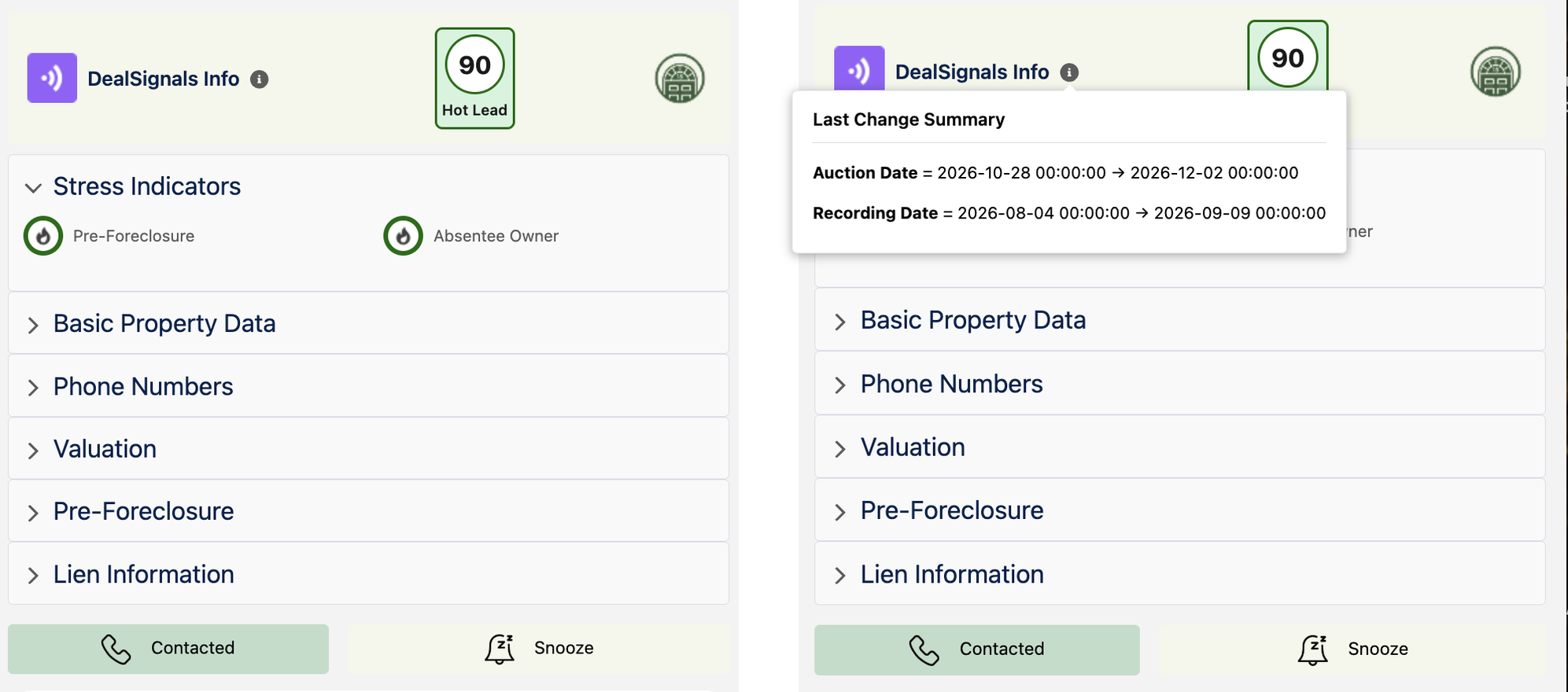
The DealSignals panel on a lead (demo record): an intent score of 90 flagged Hot Lead, its stress indicators, and the Last Change Summary showing what changed and when

The DealSignals panel on a lead (demo record): an intent score of 90 flagged Hot Lead, its stress indicators, and the Last Change Summary showing what changed and when.

Midwest Cash Offer set 6 appointments and signed 2 contracts within 48 hours of DealSignals going live (Sadie Earl, Midwest Cash Offer).

Left Main’s DealSignals figures

Left Main’s DealSignals one-pager cites 2–3 more deals closed per month, 10+ hours reclaimed every week and a 10–20% closing-rate lift from lost-deal insight, plus a 5% increase in lead-to-opportunity conversion, 1.5%–2.5% savings on acquisition prices and a 3%–5% improvement in lead-prioritization efficiency.

On the cost side, Left Main puts DealSignals’ monthly savings at $2,050–$5,250:

Cost area Left Main’s monthly savings figure
List purchases eliminated $800–$2,100
Skip tracing costs eliminated (built-in contact discovery) $400–$1,200
Administrative time savings (10–20 hours saved per month) $600–$1,200
Duplicate marketing avoided $150–$450
Tool consolidation $100–$300
Total $2,050–$5,250 per month

These are Left Main’s own figures, not a guarantee. Your results depend on your market, what you spend today on lists, skip tracing and admin time, and how fast your team follows up.

Starter ($500/month plus $3,000 implementation) doesn’t include DealSignals. Launch ($1,200/month, implementation included) adds your choice of DealSignals or DispoSignals plus Property Sales AI. Enterprise ($2,000/month, premium implementation included) includes DealSignals, DispoSignals and the Investor Portal. Salesforce licensing is included in every plan. If you already pull lists in BatchLeads, Left Main integrates with it. See pricing and the full feature list.

Who should choose which

  • You are just starting and need your first lists: PropStream, DealMachine, or PropertyRadar. Each starts at $99 to $119 a month billed monthly (PropStream, DealMachine, PropertyRadar, checked Oct 17, 2026), and you don’t need a full CRM yet. Left Main is more system than you need at this stage.
  • You find deals driving for dollars: DealMachine, which includes a Driving for Dollars app on every plan (source, checked Oct 17, 2026).
  • Your business runs on high-volume cold calling and texting: BatchLeads, which pairs list stacking with a built-in dialer (source, checked Oct 17, 2026).
  • You want stacked lists and a lead-management CRM in one subscription: DataSift (source, checked Oct 17, 2026).
  • You need alerts on a specific set of properties and a lot of search criteria: PropertyRadar, with monitored properties and property alerts on every plan (source, checked Oct 17, 2026).
  • You are a team with a large existing database, an acquisitions process, and a marketing budget: Left Main with DealSignals. It turns the database you already paid for into a source of new deals, delivers newly distressed properties from your market, and puts the signal in the same system as your follow-up, dispositions and reporting. Some teams also keep a list tool for specific campaigns. See how it works for residential investors.

FAQ

What is the best software to find motivated sellers?

It depends on what you need. PropStream, DealMachine, PropertyRadar, BatchLeads, and DataSift are built to pull and stack distress lists. Left Main REI’s DealSignals monitors property records inside a CRM and growth operating system. It flags existing leads when a new distress signal appears and delivers newly distressed properties in your market as net-new prospects.

What are the best motivated seller lead lists?

Pre-foreclosure, probate, tax default, eviction, and vacancy lists are the most common distress lists. They work best stacked with absentee ownership and high equity, so you focus on owners who have both a reason to sell and the equity to sell to an investor.

Is list stacking or property monitoring better?

They do different jobs. Stacking builds a marketing list for an area. Monitoring tells you the moment a property gets a new signal. Most growing teams use both.

How do I find motivated sellers in my existing database?

Match your old leads against fresh distress data regularly and send the matches back to acquisitions with the new signal noted. Left Main’s DealSignals does this automatically by flagging leads already in your database when a signal like pre-foreclosure or probate appears.

How fast should I contact a seller after a distress signal?

Same day if you can. Other investors see the same public records, so the first credible buyer to reach the owner has an advantage. Then keep following up for weeks or months, because many sellers aren’t ready on the first call.

Does Left Main REI include motivated seller data?

Yes. DealSignals is included in the Launch plan ($1,200/month, with DealSignals or DispoSignals) and the Enterprise plan ($2,000/month, with both). Every plan, including Starter, includes ATTOM property data in the CRM.

See which sellers in your own database are showing distress signals: book a demo of Left Main REI. Or take a self-guided test drive at leftmaindemo.com.

Related guides: How to Tell Which of Your Leads Sold to Another Investor; How to Build a Cash Buyers List; Best CRM for Real Estate Investors: 2026 Buyer’s Guide.

Sources

As of Oct 18, 2026

Your next deal, right at your fingertips.

See Left Main on your own pipeline. Book a demo, or take a self-guided test drive.

Mobile screenshot of a Left Main lead record

Stop chasing. Start closing.

Serious investors choose Left Main REI to scale faster, close more deals, and dominate their markets.

Your next deal, right at your fingertips.