
How Real Estate Investors Break Through Revenue Ceilings

Table of Contents
Most real estate investors do not hit a revenue ceiling because there is not enough opportunity.
They hit one because the business they built (and the leader they are) to get to this level is not the business that will get them to the next one.
That is why so many REI businesses stall at predictable points of growth. For most, it happens around $1 million,$3 million, $5 million, $10 million, and $15 million in revenue.
The numbers may vary slightly, but the pattern is the same.
At each stage, the bottleneck changes and there is a new “theme” to master in order to break through. If you do not see it clearly, growth slows down fast.
What Is a Revenue Ceiling?
A revenue ceiling is the point where your current systems, habits, and structure stop producing the next level of growth.
You may still have leads coming in. Your team may still be working hard. Revenue may even look okay on the surface.
But underneath it, things feel heavier than they should.
Growth slows. Complexity grows. Deals get stuck. Follow-up slips. Closings become unpredictable or inconsistent. Team members stay busy, or churn, and the business does not move forward the way it should.
That is a revenue ceiling.
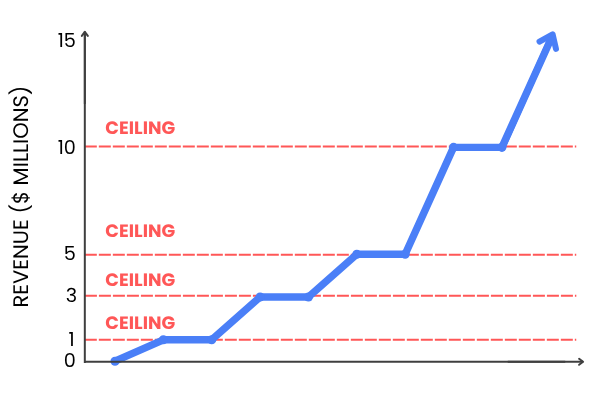
The Common REI Revenue Ceilings
Most real estate investment businesses run into a few common ceilings:
Around $1 million:
This is usually the proof-of-concept stage. You can get here through hustle, brute force, relationships, and sheer effort. But if you stay there too long, chaos catches up with you and burn out happens fast.
In order to break through, you need to build processes and systems for each team member and step of your business from Lead to Closings. These need to be well defined, documented, and communicated.
From $1 million to $3 million:
This is critical and this is where most businesses fail. This is all about Funnel Control. You need to understand how leads move through your pipeline, where they stall, and what your conversion rates actually are from each hand-off point.
In order to break through, you must make the correct diagnosis on where the leaks are in your funnel or you will continue to chase the wrong problems and create complexity when your team needs clarity and simplicity.
From $3 million to $5 million:
This ceiling is about leadership. In order to break through this ceiling you need departments. That means each segment of your business needs redundancy and leadership. 2 is 1 and 1 is none. Your leaders need to understand and then convey what success looks like and how it impacts team members upstream and downstream. Communication, collaboration, planning, troubleshooting are paramount as your team size will grow and your company will go deeper. Slowly, the owner becomes less of a bottleneck and leaders grow within your organization.
In order to grow leaders in your organization you need to have an extremely clear vision of the company mission and also extremely clear success metrics for each person and each department. This is all inherited from mastering your funnel and looking ahead to the next ceiling of mastering data and efficiencies. Owner Operators need to completely understand this first before they are able to successfully raise up leaders in their organization. Leaders worth following have vision and have a plan for success.
From $5 million to $10 million:
This is where data becomes the lever. Better reporting, better forecasting, better efficiency, and better decision-making create the next jump. One of the most important ideas here is this: Most businesses die from indigestion, not starvation. Growth does not come from finding more gold mines. It comes from extracting more gold from the one you already have and understanding where to focus.
Above $10 million to $15 million and beyond:
Now you start thinking in business units, partnerships, and business development. Growth becomes less about individual hustle and more about structure, specialization, and repeatability. For the very first time in the revenue growth of your company, you are thinking “wider.” Wider doesn’t come from new, it comes from adjacents and double-downs. These business units will each go through the same revenue growth ceiling exercise; starting with proof of concept. They each require their own focus and funnel so make sure you designate a leader to own these units and anticipate a separate team to run and contribute to it. Do not make the mistake of using the ‘core’ team for everything.
Most Businesses Do Not Die From Starvation
One of the most important ideas here is this:
Most businesses die from indigestion, not starvation.
There is no shortage of ways to make money in real estate. The problem is not usually opportunity. The problem is trying to do too many things without enough clarity, process, or control.
Too many lead sources. Too many moving parts. Too many guesses. Too many fires.
Growth does not come from finding more gold mines.
It comes from extracting more gold from the one you already have.
The Real Estate Investing Funnel Is the Foundation
No matter what ceiling you are pushing through, the funnel matters.
In most REI businesses, the funnel looks something like this:
Leads → Opportunities → Appointments → Offers → Contracts → Closed Deals
Every handoff matters. Every conversion matters.
If you do not know what “normal” looks like at each stage, you do not know where the real problem is.
That is where many teams get stuck. They assume they need more marketing, more leads, or more people, when the real issue is lower in the funnel.
The Real Problem Is Lack of Visibility in Your Deal Pipeline
You cannot fix what you cannot see.
That is why operators need visibility into the full funnel, not just activity at the top.
You need to know:
- Are leads being answered fast enough?
- Are qualified opportunities getting to appointment?
- Are appointments turning into offers?
- Are offers being accepted at a healthy rate?
- Are contracts actually closing?
- Are marketing decisions being made from real conversion data or guesswork?
Without that visibility, every decision becomes reactive.
You cut the wrong channel. You coach the wrong person. You blame the wrong department. You spend more money when the real problem is process.
What Changes at Each Stage of Growth
Breaking through a ceiling means solving the bottleneck for the stage you are in.
At earlier stages, that usually means building process and getting control of the funnel.
At mid-stages, it means leadership, accountability, and department structure.
At larger stages, it means using data to make faster, better decisions and improving efficiency across the business.
At more advanced stages, it means expanding through partnerships, business development, and repeatable business units.
The lesson is simple: the thing that got you here is usually not the thing that gets you there.
Why Left Main Helps
Left Main helps REI businesses break through revenue ceilings by giving teams visibility into the full deal pipeline because it was built specifically for teams and leaders..
Instead of guessing where deals are getting stuck, you can actually see it.
Instead of managing from memory, you can manage from dashboards.
Instead of reacting to problems after revenue drops, you can catch bottlenecks early and fix them faster.
That matters whether you are trying to get out of hustle mode, improve conversions, build stronger departments, or operate from better data.
Final Thought
If your business feels stuck, it does not always mean you need more opportunity.
It may mean you have reached the limit of your current systems.
Revenue ceilings are normal. Hitting one does not mean your business is broken.
It means the next version of the business and the leader needs to be built.
And the faster you can see where the bottleneck is, the faster you can break through it.
Every second counts. Know which seller to call first.
Get real-time alerts on motivated sellers before your competition. Access live property insights and stress indicators.

Stop chasing. Start closing.
Serious investors choose Left Main REI to scale faster, close more deals, and dominate their markets.
Your next deal, right at your fingertips.
Stephanie is the CEO and Founder of Left Main REI, where she leads the company’s mission to help real estate investors scale with better data, systems, and execution. Under her leadership, Left Main has grown into a category-defining CRM and AI platform built specifically for serious real estate operators.
In addition to Left Main, Stephanie is the co-founder of Better Path Homes, a successful real estate investment company based in Charlotte, NC. With a background as a Cardiothoracic Surgery Nurse Practitioner, she brings a rare combination of operational discipline, decision-making under pressure, and people-first leadership to building high-performing businesses.